
Soft skills This concept, which is becoming increasingly common in recruitment and managerial assessment processes, reflects a major change in the world of work. Today, behavioral competencies - also known as "soft skills" - are more and more important. soft skills - play as decisive a role in professional success as technical skills. Adaptability, leadership, interpersonal communication, team spirit: these are all soft skills that employers are looking for, but which are often difficult to objectify.
The personality tests can be used to more reliably assess these human, emotional and relational skills. Used during job interviews, as part of a skills assessment or as part of a leadership coachingThey help recruiters, HR departments and managers to better identify a colleague's key skills.
This article offers a comprehensive, practical approach: definitions, recognized psychometric models, a comparison of the most commonly used tests, and tips for develop your behavioral skills in a professional context.
Objective To provide you with a solid framework for understanding tests, choosing the right tool, and making the most of the results to boost your individual performance or that of your teams thanks to soft skills.
What are soft skills?
A soft skill is a behavioral, social or emotional skill that influences the way a person interacts, communicates and adapts in a professional environment.
Unlike hard skills (technical skills), they are not linked to a specific profession and are transferable in all contexts. Examples: communication, leadership, empathy, professional adaptability, stress management.
What is a soft skills personality test?
A soft skills personality test is a psychometric assessment tool that measures human human aptitudes such as communication, empathy, adaptability and problem-solving. Unlike technical tests, it focuses on natural behaviors of an individual in a professional situation.
It can be integrated into several contexts:
- Recruitment and integration
- Management coaching
- Conflict management or internal mobility
- HR development plans
Soft skills vs hard skills: what's the difference?
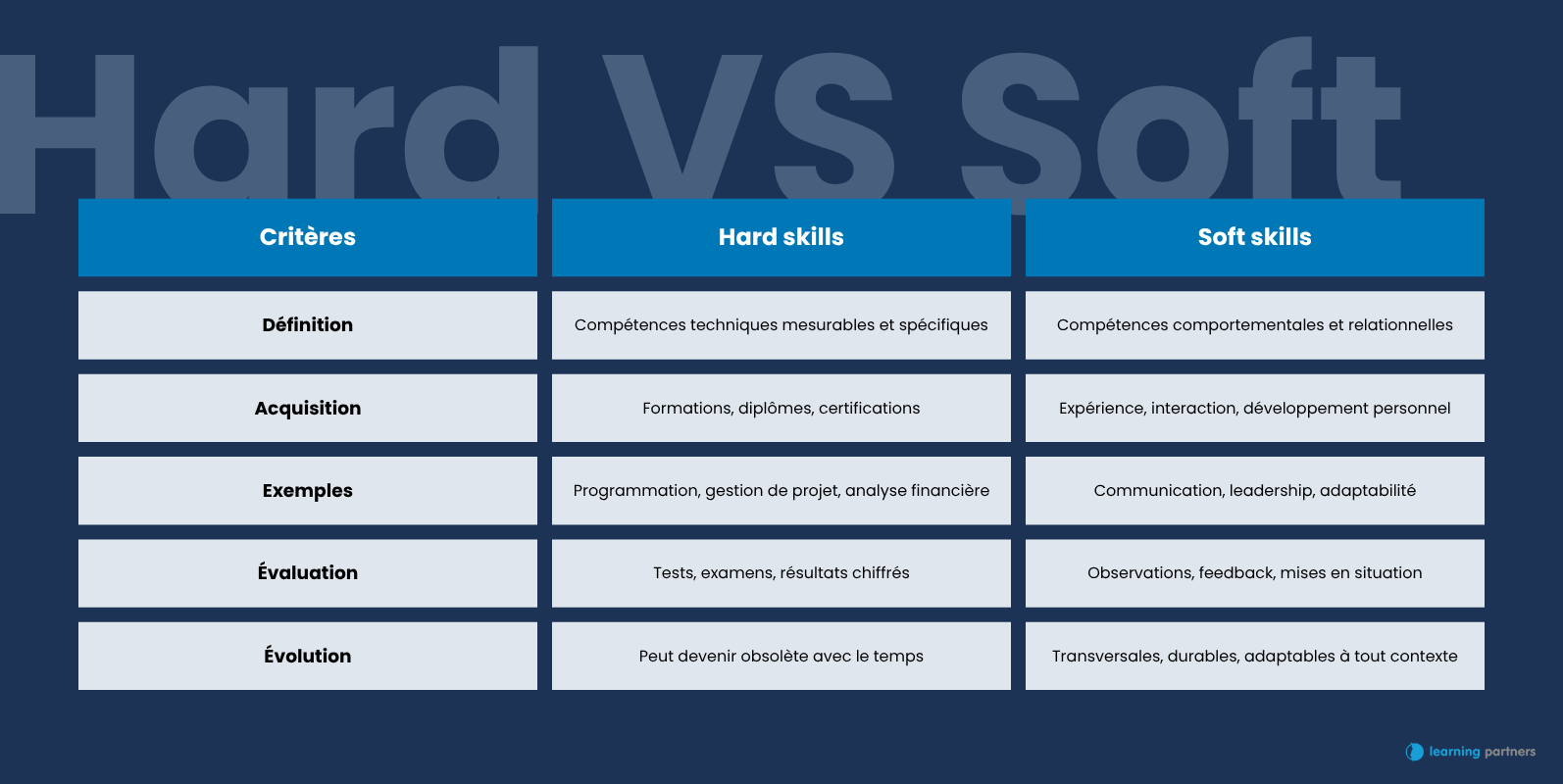
In a nutshell, hard skills are what you can dosoft skills show how you do it.
But because a picture is worth a thousand words, here's a chart illustrating the difference between hard and soft skills.
Why use a personality test in the workplace?
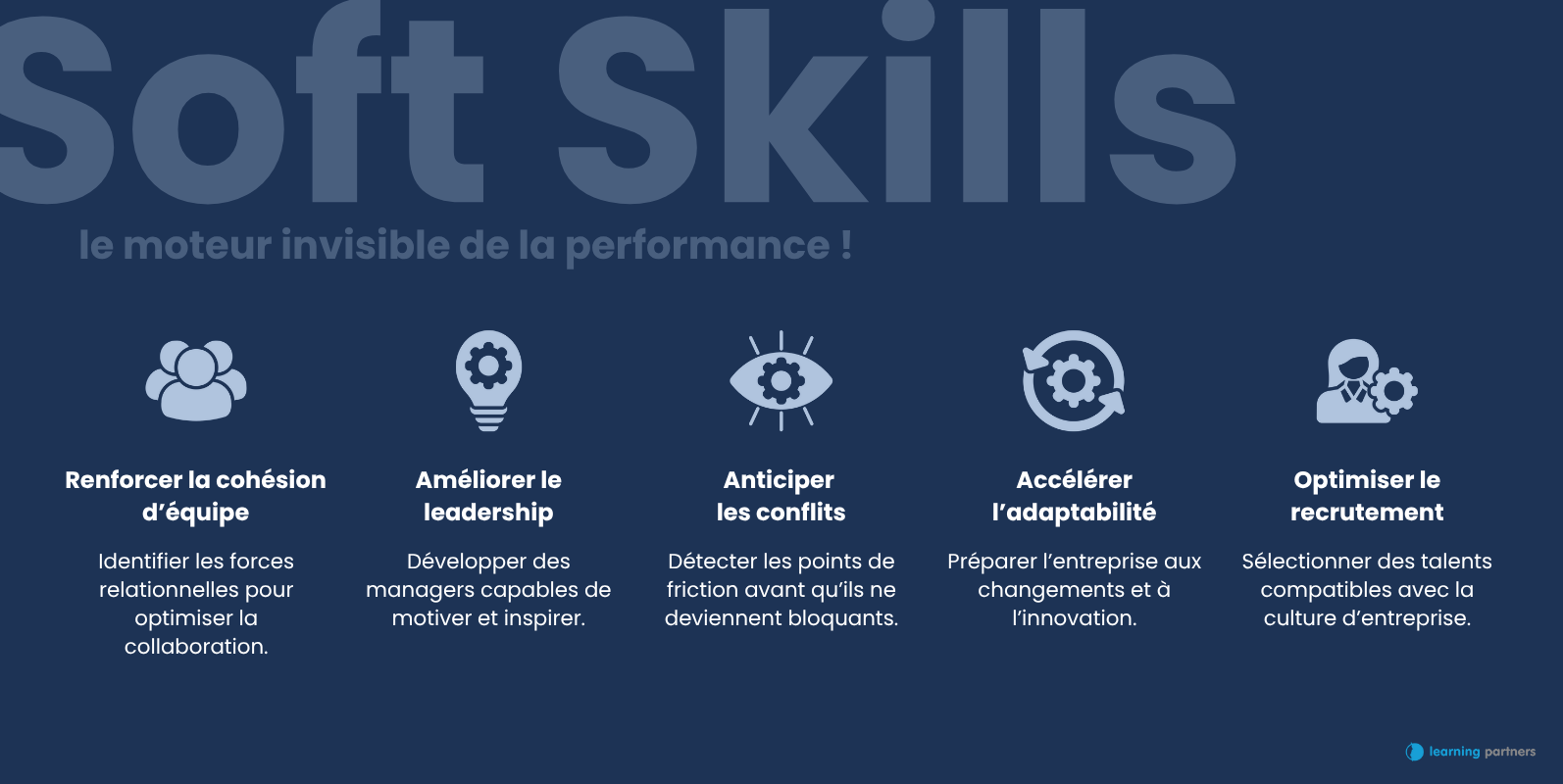
Today, soft skills are perceived as key indicators of human performance. The tests make it possible to :
- Objectivizing qualities that are sometimes invisible
- Identify untapped potential
- Preventing team tensions
- Create more more coherent and complementary teams
Key benefits :
- HR decision support
- Optimizing integration paths
- Save time on recruitment
- Personalizing managerial career paths
The personality tests most commonly used to assess soft skills
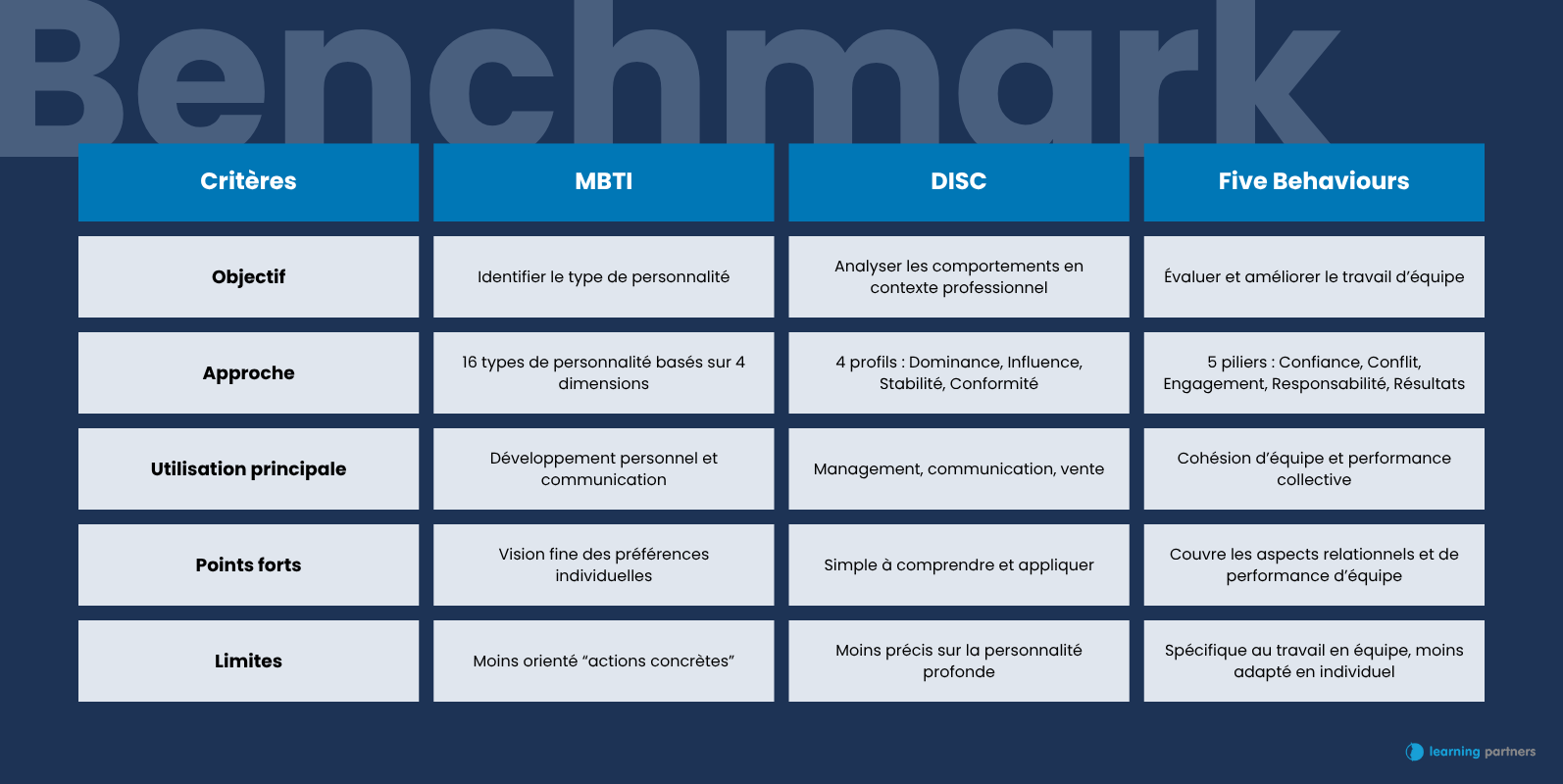
1. Five Behaviours: unleashing teams' full potential
Five Behaviours is a collective assessment and development tool based on five essential pillars: trust, conflict management, commitment, responsibility and results. Designed to strengthen cohesion and performance, it offers organizations a clear method for transforming a group of employees into a cohesive, aligned team focused on achieving common goals.
2. DISC: Behavior & communication
The DISC identifies an individual's dominant, influential, stable or conscientious styles. Ideal for subjects such as management, communication or sales.
3. MBTI: 16 personality types
The MBTI tool classifies individuals along 4 axes, giving rise to 16 profiles. Used in personal development and team management. It gives a more precise vision of each individual within an organization.
Learning Partners, expert in soft skills diagnosis and development
Our approach is based on :
- Validated psychometric tools
- Results-oriented coaching paths
- Interactive diagnostics with personalized feedback
Our customers: executives, HR managers, training managers, senior managers.
Shall we get started?
Book a 30-minute appointment with a Learning Partners consultant to find out how our approach can transform your management.

Soft skills, the hidden engine of performance
Soft skills are not only unique and highly personal, they are also key competencies for business performance.
At the same time personality tests have become essential allies in identifying, understanding and developing the human skills essential to collective performance. They provide concrete data, reinforce self-knowledge and enable organizations to steer their managerial transformation with finesse.
Make an appointment today with a Learning Partners expert to benefit from a personalized mini-diagnosis and discover the concrete levers for developing your leadership posture.
FAQ: the importance of soft skills
Can you really develop your soft skills?
Yes, thanks to coaching, feedback, experiential training and behavioral analysis.
What's the difference between a personality test and a soft skills test?
A personality test identifies psychological traits; a soft skills test translates them into observable and activable skills.
Is it useful even if I'm already a manager?
Yes. Experienced managers benefit greatly from the tests, particularly in terms of adjusting their relational posture and promoting cohesion.
Phone
+41 22 510 25 15
+33 6 40 83 53 55
Address
68 Route du Stand,
VD1260 Nyon, Switzerland

