
Every technical expert promoted to manager faces the same shock: yesterday a recognized specialist, today responsible for an entire team.
Six months ago, she was your top engineer. Today, she manages six people—and her team is running out of steam. This isn't an isolated case.
Every year, dozens of technical experts move into management because they excelled in their field—rarely because they already knew how to manage. Middle management remains one of the most fragile turning points in a company, and managers promoted from within are often the first to pay the price: conflicts arise, teams lose their autonomy, and decisions are too often escalated back to the manager himself or herself.
Technical competence and managerial competence are not the same thing. Here are the three most common interpersonal pitfalls among recently promoted managers—and how Everything DiSC® helps identify them before they take hold.
Pitfall #1 — Expecting the team to work “the way I do”
A manager who has been promoted for their expertise usually has a distinct way of thinking: getting straight to the point, checking every detail, or making quick decisions. The natural tendency is to expect the same from the entire team—and to get frustrated when that isn't the case.
At a fast-growing industrial company we worked with, several recently promoted managers admitted that they wanted their employees to “think like them”—until they discovered, once they had their Everything DiSC® profiles in hand, that this expectation was precisely the source of the tension. A team that operates on the same instincts as its manager doesn’t perform any better; it’s simply more predictable to the manager.
What Everything DiSC® changes: Managers can see their own natural tendencies and those of each employee through a shared framework. Diversity in leadership styles ceases to be an obstacle to manage and becomes a resource to harness.
Pitfall #2 — Doing It Yourself Instead of Delegating
When a problem drags on, a technical expert who has been promoted to manager often instinctively tries to solve it himself—the faster, the better, with no discussion. In the short term, this is reassuring. In the medium term, it robs the team of autonomy and overloads the manager, who ends up managing… by doing his employees’ work.
As part of the same support program, the process included an individual Everything DiSC® Management assessment—which featured a delegation report—supplemented by practical workshops on feedback and performance review conversations. Six months later, 17 of the 18 managers who received coaching had implemented at least one observable change in their practices, according to feedback from the human resources department.
What Everything DiSC® changes: For each style, the delegation report explains what motivates an employee to take charge of a task—and, conversely, what leads them to wait for instructions. Delegating becomes a skill that is tailored to each individual, not a one-size-fits-all approach.
Pitfall #3 — Avoiding Conflict Rather Than Channeling It
A technician is trained to solve problems, not to mediate between people. When faced with tension within the team, the instinct is often to avoid the issue, hoping it will resolve itself—or, conversely, to make a blunt decision to “get it over with.” In either case, the tension resurfaces elsewhere a little later.
In this same industrial context, the reduction in HR reports related to managerial tensions reached 40% over the six months following the coaching. The key was not to eliminate disagreements, but to provide managers with a framework for understanding what triggers friction: a results-oriented style that wants to move quickly, a stability-oriented style that needs time, and a precision-oriented style that wants to do things right before moving forward.
What Everything DiSC® changes: Managers learn to identify these triggers before they escalate, and to adjust their own response rather than waiting for the other person to change first.
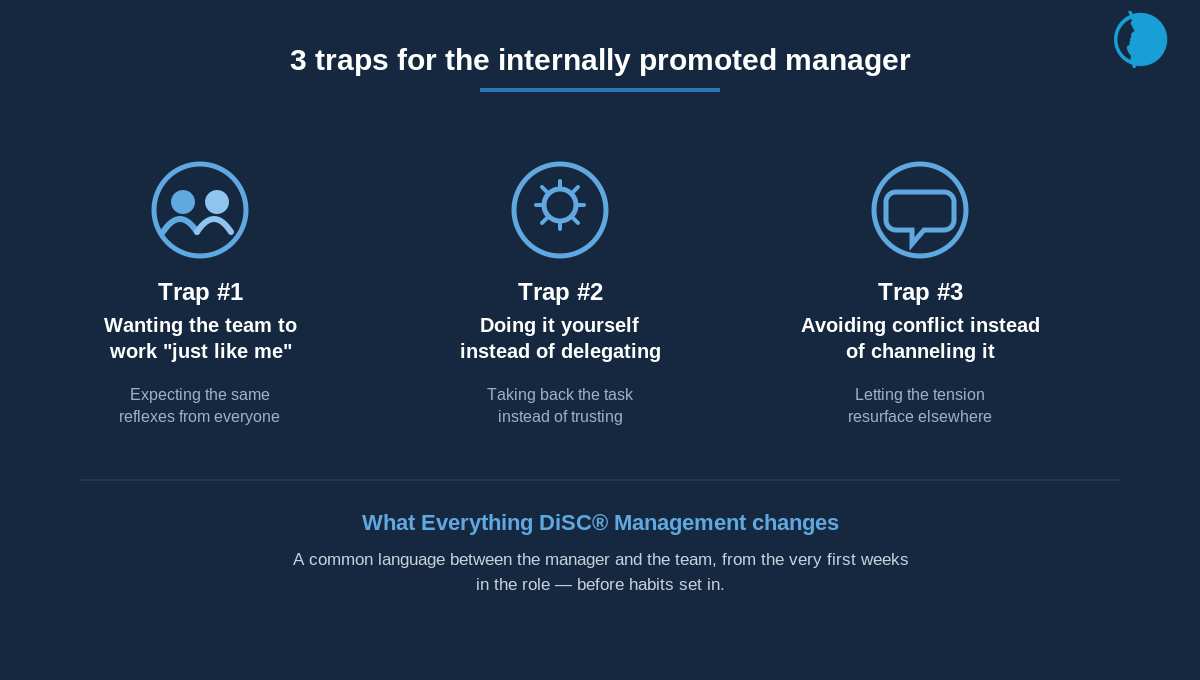
What this actually means, starting in the first few weeks
None of these three pitfalls can be resolved with a motivational speech or a mission statement. They are resolved through a shared language, practical tools, and a better understanding of one’s own natural tendencies—starting in the first few weeks on the job, before habits become ingrained.
And what about you: When was the last time you asked one of your recently promoted managers how they’re really finding their new role?
Do you support recently promoted managers in your organization? Let’s discuss how Everything DiSC Workplace or Management can help ensure a smooth transition— contact Learning Partners.

